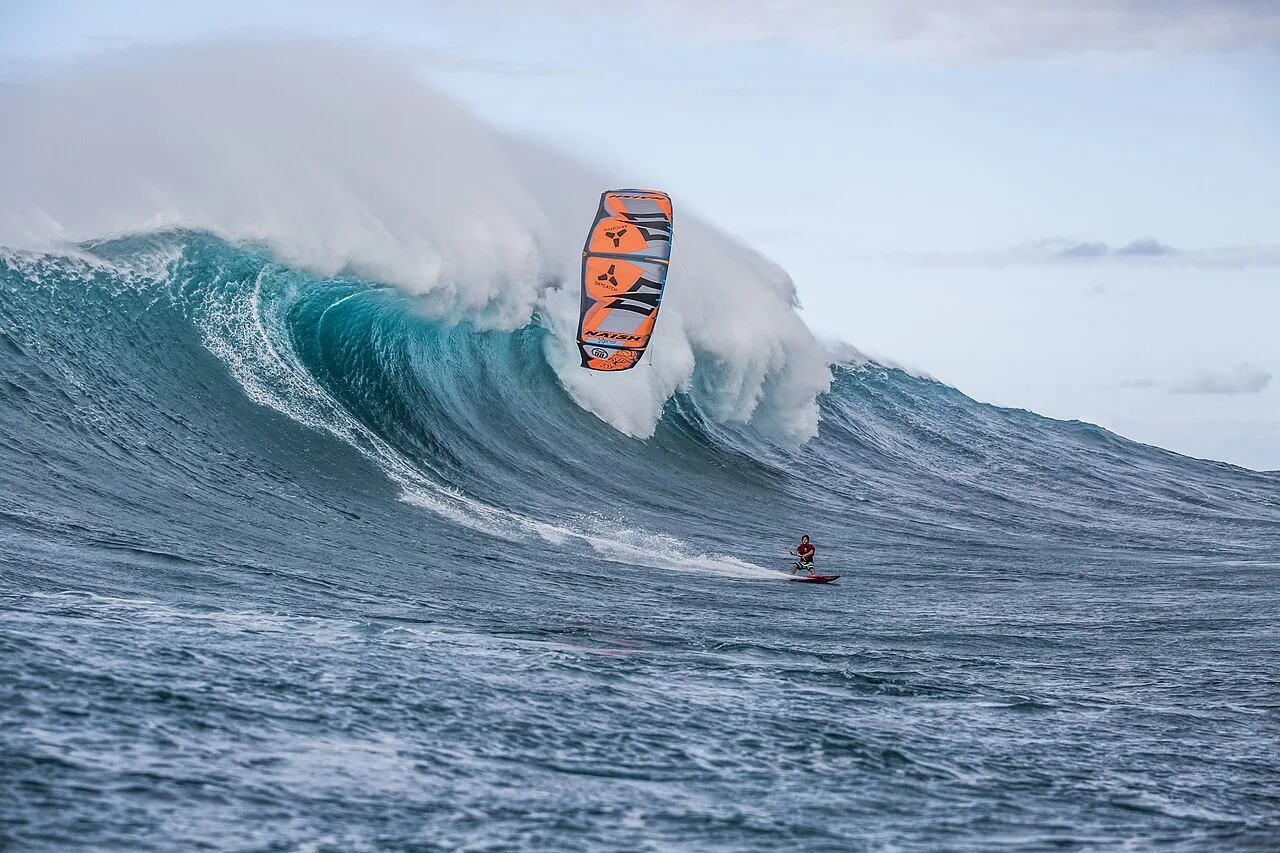
The short version
- Selection is by documented contribution, not a universal ranking.
- Women and men belong in the main story across disciplines.
- Awards, records, event wins and championships need their own labels.
A “best kiteboarders” list usually becomes a mixture of fame, personal taste and incompatible title counts. That can be entertaining, but it is a poor way to understand how the sport developed.
A more useful selection asks what a person contributed and where the evidence is. It leaves room for different generations, women and men, competitive results and work that never produces a podium.
Six useful entry points
Bruna Kajiya: staying relevant in freestyle
GKA’s 17 December 2025 freestyle account confirms Kajiya’s sixth Freestyle world title at Taíba in 2025. That dated organiser account is more reliable for the title at that point than an older biography with a stale cumulative total.
Watch freestyle to understand the skill behind the achievement: controlled execution, different trick families and the pressure of attempts inside a heat. A later event win should still be recorded as that event, not silently added as another season title.
Jesse Richman: the big-air event as a historical lens
Richman’s 2013 and 2020 King of the Air wins provide two clear points in modern big-air history. Red Bull’s event history places the original event in Maui and the 2013 return in Cape Town.
His profile uses those dated results to explain why venue and era matter. A win does not become more interesting by attaching an unsupported all-time height record to it.
Aaron Hadlow: a career across competitive eras
Hadlow’s own achievements page presents five consecutive world titles and later big-air work. It is an athlete-authored career account, which should remain attributed until each result is reconciled with its original championship record.
The interesting angle is continuity and change: what carries from technical freestyle into another competitive environment, and what the later format asks differently. It is more useful than treating every title system as identical across decades.
Capucine Delannoy: distinguish the tasks within Kite-Surf
Delannoy’s GKA athlete identity and North portrait provide starting points into wave and strapless riding. Manufacturer title totals remain attributed unless checked against exact season results.
Her competitive context helps explain why a wave turn and a strapless aerial belong to related equipment traditions but different performance tasks. Watch with the edition’s format visible.
Giel Vlugt: innovation has more than one kind of recognition
The 2022 GKA awards report names Vlugt as Male Rider of the Year and Men’s Move of the Year winner for an S-Loop. Those are specific awards, not a claim that he won every relevant championship.
Innovation also requires precise language. A “world first” needs a defined move and dated original evidence. An exciting clip or a later biography is not enough to resolve every version of that claim.
Lauriane Nolot: racing belongs in the story
Nolot brings a different competitive problem: course racing, positioning and decisive finals. World Sailing’s August 2024 account documents the women’s Olympic final and her silver medal. Her FFVoile profile provides a broader federation record.
Keep Olympic, world, continental and individual regatta achievements separate. A racing career should not disappear because its most important decisions are less obvious in a short video.
How to judge a future addition
| Contribution | Useful evidence |
|---|---|
| Competitive achievement | Final event or season record with discipline and category |
| Technical innovation | Dated original footage and a clearly defined claim |
| Design work | Attributable technical or manufacturer records |
| Film and storytelling | Original published project and the person’s documented role |
| Access and participation | Named initiative, direct records and actual outcomes |
This approach has omissions. Local contributors and earlier eras often need more original reporting than an elite athlete page. Missing them should prompt research, not a claim that the current collection is definitive.
Use the right comparison
GKA rankings separate disciplines and categories. IKA results belong to a different racing ecosystem. There is no official combined table that makes their performances directly interchangeable.
Choose people to watch because their contribution interests you. Use the source dates to understand what is historical, current or still unresolved. An editorial favourite does not need a fictional universal ranking to earn a place.
Something changed?
Conditions, access and prices change. If something needs updating or correcting, tell us. Get in touch ↗